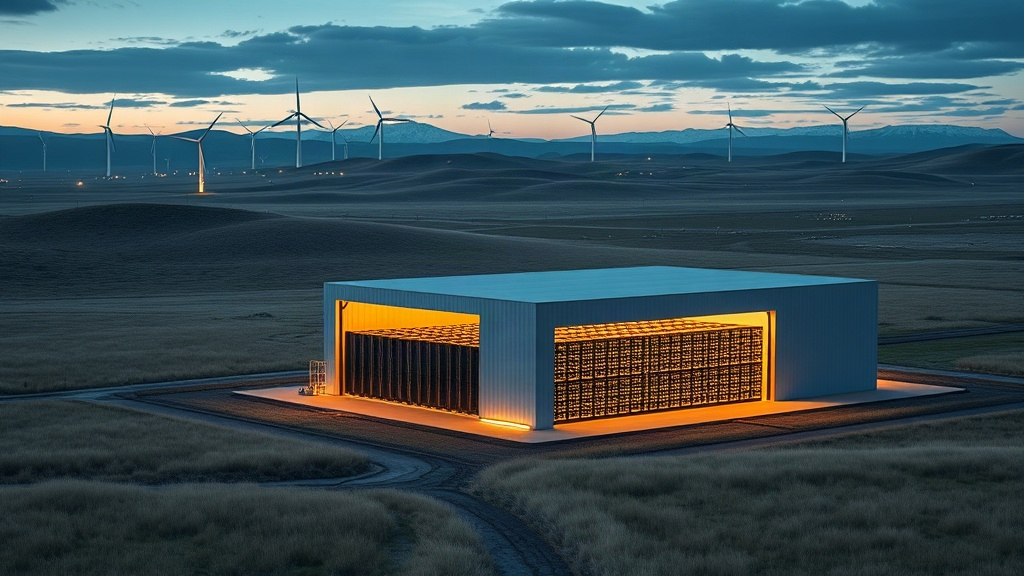
Ulanqab, a city 350 kilometers northwest of Beijing, has quietly become the global epicenter of AI infrastructure investment. With 89 active data center projects and over 5 million standard racks already committed, Inner Mongolia is concentrating Chinese AI capacity at a scale that’s reshaping global compute economics—and the cost advantage built there is directly hitting your cloud bills.
The story here isn’t really about geography. It’s about competitive physics: electricity costs in Inner Mongolia run roughly one-third the rate of Beijing or coastal hubs. Land is abundant. The climate is cold enough that cooling costs collapse. Proximity to government centers matters for approvals and policy alignment. Three of those four factors are structural; they don’t disappear.
What emerged from this is now scale without precedent. Envision Group completed the first phase of what is being called the world’s largest single AI data center in Ulanqab, spanning 120,000 square meters—roughly 20 football pitches—with capacity to run 1 million AI chips in parallel. DeepSeek, the startup that shook Silicon Valley’s confidence in late 2025, is committing 1 gigawatt of new compute there. More than a dozen firms have projects planned in the city; across Inner Mongolia, 28 large or medium-sized computing projects were under construction or renovation in the first half of 2026 alone, with combined investment estimated at 117.5 billion yuan.
How Cheap Power Reshapes the Global Compute Floor
Here’s why you should care: that infrastructure concentration is a direct lever on global API pricing. When your competitor can train and run inference on infrastructure where power costs one-third of yours, the math doesn’t close for margin-sensitive work.
Chinese API pricing has already collapsed into a realm that Western vendors can’t match without restructuring their entire cost model. Chinese AI models now compete on cost efficiency in ways that suggest this isn’t a temporary pricing war—it’s structural. DeepSeek’s V3 was trained for roughly $5.58 million. GPT-5 training budgets routinely exceed $100 million. When you’ve got infrastructure that cheap, you can afford to run inference at rates most Western operators can’t touch and still move toward profitability as volume scales.
The pricing data confirms it. By August 2026, average inference prices on major APIs had compressed further, and Chinese vendors are pushing pricing 70–97% below Western baselines in specific segments. OpenAI and Anthropic cut rates defensively, but they’re not gaining margin; they’re fighting volume share against competitors with fundamentally lower cost floors.
Now consider what happens when you run a 35-person software company or a 100-person professional services firm that embeds AI into your core product. Your SaaS margins depend on keeping per-user infrastructure costs flat or declining. Three years ago, that was a reasonable bet. Today, you’re watching your vendor’s cost structure get undermined by geographically asymmetric infrastructure economics in a place you can’t access directly.
The cost dynamics aren’t limited to cloud APIs. If you’re self-hosting language models—running inference in-house to control data or latency—your electricity cost per query is competitive with Chinese utility pricing only if you’re in regions with abundant hydroelectric or geothermal power. For most of Western Europe, that’s not your situation. Your per-token cost structure is already at a disadvantage you can’t negotiate away.
What This Means for Your Vendor Strategy
This is where competitive advantage shifts hands, and it’s not yet priced into vendor contracts. Most European SMB and mid-market procurement still assumes Western cloud pricing as the baseline. It’s not. The baseline is now set by whoever can tap the cheapest power and scale infrastructure without Western regulatory friction.
The second implication is supplier concentration risk. If 89 data center projects converge on a single city, redundancy and geographic hedging become harder. A power outage, a regulatory shift, or a supply-chain disruption to that region could ripple globally. But that’s a distant concern compared to the immediate one: as inference workloads move to the cheapest infrastructure, execution speed and latency become differentiators instead of raw compute count. Chinese semiconductor alternatives are maturing faster than expected, which means Western chip reliance doesn’t guarantee pricing power anymore.
What should you do? First, stop treating “cloud compute cost” as a fixed line item in your budget. It’s not. Model your unit economics around 10–15% annual cost decline for commodity inference, and treat that as a minimum. Second, pressure your vendors to lock in pricing commitments tied to transparent cost indices—not hand-waving about “market conditions.” Third, consider whether self-hosting specific high-volume inference workloads makes sense for your margin structure. It probably does if you’re running 10 million+ tokens per month and your end-user latency tolerance allows for it. Fourth, start mapping your supplier concentration risk now. If your core vendor is pricing off Chinese infrastructure but has Western regulatory exposure, you need to understand how that tension resolves.
And if you’re planning infrastructure investment of your own in Europe, invest in access to renewable power first, everything else second. That’s where your competitive edge sits now.




0 Comments