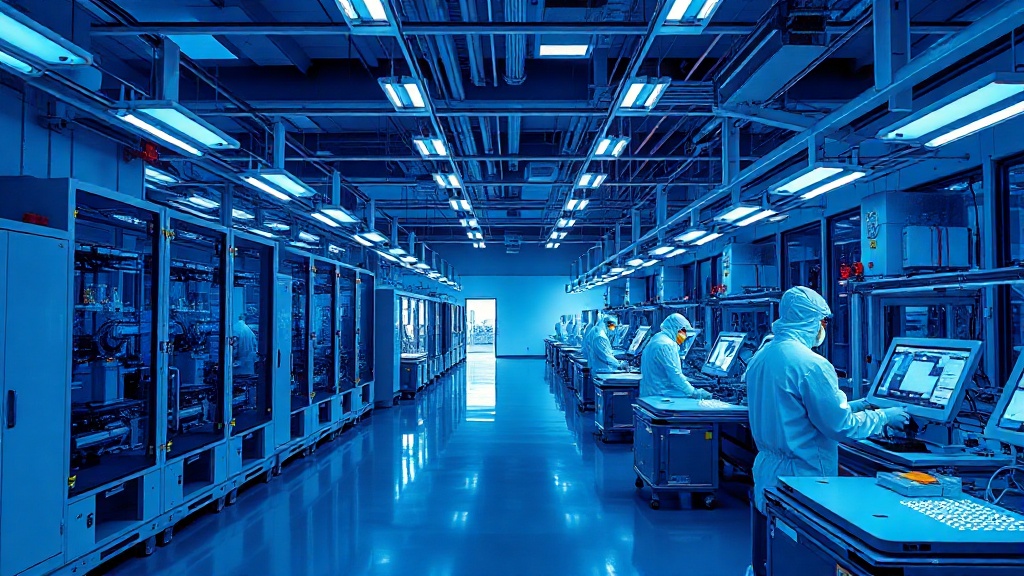
TSMC reported a 45% revenue surge in July driven by insatiable AI infrastructure demand—but here’s what matters: Big Tech is consolidating chip supply, memory is sold out through 2026, and mid-market companies planning AI investments are entering a bidding war they can’t win. The question isn’t whether you’ll buy AI chips; it’s when to lock in capacity before prices spike further.
TSMC’s July revenue hit NT$467.58 billion (US$14.5 billion), up 44.7% year-on-year, with high-performance computing (AI chips) now accounting for 66% of total revenue. The company raised its full-year capex forecast to $60–64 billion—a record spend meant to expand AI fabrication. Sound like booming demand for everyone? It’s not. It’s a supply squeeze playing out differently depending on which tier of the market you’re in.
The real story sits two levels below the headline: Big Tech has won the chip allocation race, and everyone else is now competing for scraps.
How Big Tech Locked Down the Supply Chain
TSMC manufactures chips for Nvidia, Google, AMD, and Apple. None of these are mid-market. In 2026, hyperscalers—Microsoft, Google, Meta, Amazon—are pouring roughly $700–725 billion combined into AI infrastructure capex, up 65%+ year-on-year. TSMC’s second-quarter earnings showed that “demand significantly outpaces supply and isn’t showing any major sign of slowing down,” according to analyst William Li at Counterpoint Research. This demand isn’t latent or speculative. It’s locked in through multi-year commitments.
The constraint is acute on two fronts. First, TSMC’s advanced-node wafer capacity—the 3-nanometer and 5-nanometer processes that power AI accelerators—is oversubscribed by roughly 3x according to industry analysis. Nvidia alone has reportedly booked 60% of TSMC’s CoWoS (Chip-on-Wafer-on-Substrate) advanced packaging capacity through 2026, plus more than half of the 2026–2027 expansion. Second, high-bandwidth memory (HBM) is a structural bottleneck. A single next-generation Nvidia B300 GPU requires 96 individual DRAM dies just for its HBM modules. SK Hynix, Samsung, and Micron have reallocated roughly 95% of their HBM production to AI data centers. Consumer electronics DRAM prices have surged nearly 700% in the past year as a result.
For a mid-market company—a 40-person logistics firm, a 200-person fintech, a 150-person healthcare SaaS—this reallocation means you’re buying from whatever inventory remains after hyperscalers take their allocations.
What This Means for Your AI Infrastructure Budget
If you’re planning an AI infrastructure investment right now, you face three hard constraints:
Lead times: Even H100 GPUs, the previous-generation standard, have 8–10 week lead times for enterprise buyers as of July 2026. Blackwell B200 units—the newer, more efficient chips—were sold out through mid-2026 with reported backlogs exceeding 3.6 million units. If you place an order today for B200 hardware, expect delivery in 18+ months, or settle for older Hopper-class chips that are less efficient but immediately available.
Pricing volatility: H100 and H200 contract pricing rose roughly 40% between October 2025 and March 2026, driven by memory cost pass-throughs from Samsung and SK Hynix. Cloud rental rates span from $2.50/hour on specialized GPU providers to $6.50+ per hour on hyperscaler platforms. That cost variance reflects who has priority allocation. A mid-market buyer renting cloud GPU capacity or purchasing enterprise hardware will land somewhere in the premium tier—you’re paying for whatever is left in inventory, not for supply-demand equilibrium.
Capacity collateral damage: This isn’t a temporary shortage. Memory manufacturers have structurally reallocated capacity away from consumer electronics toward AI. The Synopsys CEO told CNBC in January that the chip “crunch” will continue through 2026 and 2027, with new fabrication capacity taking a minimum of two years to come online. Hyperscale cloud providers signed long-term supply agreements that lock up production at premium prices. Mid-market buyers have no multi-year commitments. You’re a spot-market buyer in an allocation regime.
Three Paths Forward—And What Each Costs
You have three strategies, each with real trade-offs:
1. Cloud rental (on-demand): Pay premium rates ($4–7/hour per H100 on hyperscaler platforms) for instant access. No capex, no facility risk, but costs compound monthly. A modest fine-tuning workload running 24/7 for three months could burn $50,000+. Inference costs have dropped 30–40% since January 2026 due to software optimization, but training remains expensive.
2. Reserved capacity with neocloud providers: Negotiate 6- or 12-month reserved rates with specialized GPU rental providers (not hyperscalers). Rates drop 40–70% below hyperscaler on-demand pricing for the same hardware, to $1.50–3/hour for H100s. The catch: you’re locking capital into a single provider, you have less geographic flexibility, and if your workload shifts you’re stuck paying for unused time.
3. Hybrid colocation + dedicated infrastructure: Purchase hardware (or lease it with vendor financing) and colocate in a third-party data center. TCO over 3–5 years is typically 42% lower than pure cloud, but you assume procurement risk, hardware obsolescence risk, and operational burden. This only works if your AI demand is predictable and sustained.
Most mid-market companies shouldn’t be making binary bets on ownership. If you have variable AI demand—experimentation, fine-tuning, research spikes—cloud is rational despite the cost premium. If you have steady-state production workloads (inference pipelines running 24/7, recommendation engines, fraud detection), hybrid models (baseline production on reserved capacity, burst to cloud during peaks) deliver the best risk-adjusted returns.
The Pricing Window Is Closing
Here’s the urgent part: chip prices and availability are starting to stabilize after hitting a peak earlier this year, but this is a temporary reprieve, not a lasting trend. TSMC’s capex surge—$60–64 billion in 2026—is meant to ease constraints, but it won’t translate to spare capacity for mid-market buyers. It’s designed to keep pace with hyperscaler demand, not to create supply above that. By late 2026 and into 2027, as hyperscalers deploy next-generation Blackwell hardware at scale, older-generation H100/H200 chips will drop in price as they shift to inference and cost-conscious workloads. Conversely, Blackwell training capacity will remain scarce and expensive.
If you’re planning an AI infrastructure commitment, the optimal move is to negotiate reserved capacity with a neocloud provider now—lock in 12-month rates before the next scarcity cycle, when hyperscalers again pre-commit the majority of available supply. Don’t wait for “better pricing.” Better pricing in mid-market semiconductor markets rarely happens because supply is driven by capex cycles that operate on multi-year horizons.
What TSMC’s Numbers Actually Tell You
Why is TSMC raising capex if demand is being met?
TSMC’s capex increase to $60–64 billion signals that demand still vastly exceeds supply. The company is investing to expand capacity, not to meet current orders—it’s playing catch-up. CEO C.C. Wei stated that “AI-related demand continues to be extremely robust,” with demand about 3x greater than available capacity. New fab buildouts in Taiwan and Arizona won’t produce volume until 2027 or later. In the interim, TSMC continues to allocate advanced node capacity by customer priority (i.e., deal size, long-term commitment, and financial risk). Mid-market buyers have neither the scale nor the commitment depth to rank high in that queue.
Does TSMC’s revenue surge mean the shortage is ending?
TSMC’s revenue growth reflects pricing power and utilization, not slack capacity. The company is running near 100% utilization on advanced nodes. A 45% revenue surge means TSMC is making more money per unit while producing roughly the same total volume—that’s a supply-constrained market dynamic, not a supply-abundant one. If supply were abundant, prices would fall and revenue would contract. The inverse is happening.
Will H100 prices crash once B200 ships at scale?
Partially. Secondary-market H100 prices have already collapsed 85% from late-2023 peaks ($40,000 to $6,000), but new H100 street pricing has stabilized around $27,500 because HBM memory and advanced packaging costs remain fixed. Once Blackwell B200 volume reaches scale (late 2026 or 2027), H100 inference rental rates will drop further, but training-capable H200 supply will remain constrained. Mid-market buyers chasing the cheapest per-GPU-hour rate will eventually get it—but by then, your original use case may have shifted, or your competitor may have locked in capacity first.
Your Move
The practical implication: don’t treat AI infrastructure as a spot-market purchase. It’s a supply-constrained capital allocation decision. If you need AI compute in the next 6–12 months, negotiate reserved capacity with a neocloud provider at rates locked in today. If your use case is flexible or experimental, cloud rental from a hyperscaler is rational despite the cost, because you’re buying optionality, not a long-term bet. If you have sustained production AI workloads, explore colocation or hybrid models with your infrastructure team, because the TCO math shifts dramatically when you’re running steady-state pipelines.
TSMC’s surge isn’t a signal that chip supply is solved. It’s evidence that Big Tech has won the supply-chain race and is consolidating further. The question for mid-market companies is no longer “when will chips be abundant?” It’s “am I securing capacity before the next scarcity cycle locks me out entirely?”



0 Comments