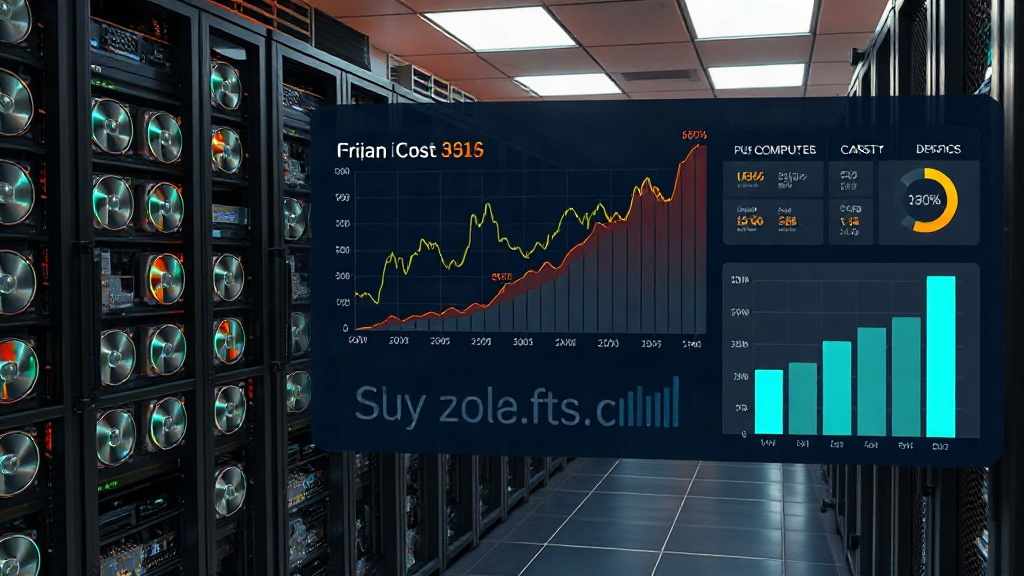
Indian fintech Groww announced during Q2FY27 earnings that it’s building its own in-house AI stack to cut per-token costs—a decision that reveals something uncomfortable for European SMBs: the third-party API model breaks down at scale. Groww’s cost crisis is your warning signal.
Groww’s announcement is not an emerging-market curiosity. It’s a structural warning about who survives the API cost transition and who doesn’t.
The Indian fintech reported that cost to serve rose 24% quarter-over-quarter in Q2 FY27 (from Rs 166 crore to Rs 206 crore), driven largely by AI infrastructure spending. Not growth cost, not marketing. Just the bill for running inference on third-party models scaled across their customer base. At that trajectory, outsourced models become the anchor dragging unit economics under water.
So Groww did what capital-rich companies with engineering depth do: it decided to build its own AI infrastructure. Co-founder Lalit explained the reasoning bluntly: “we like to do everything in-house, so we are building our own in-house stack.” The math is simple—relying on third-party commercial models would cost far more. Better to absorb the cost and complexity of building your own infrastructure than to watch per-token billing flatten margins forever.
Here’s why this matters to European SMBs: you’re on the same path, just further upstream.
The math catches everyone eventually
The cost inflection point is structural. According to Cmarix’s 2026 AI economics guide, an AI tool at $2,000 monthly during pilot adoption will require $40,000 monthly for full production. At that point, third-party API costs (Claude Sonnet costs $2 input/$10 output per million tokens) become harder to justify, and building your own inference layer—or switching to open-weight models—starts to pencil out.
For a customer-facing AI application—a recommendation engine, a document processor, a fraud detector—this scaling cost is inevitable. A logistics company with 40 people running AI-assisted order routing will see its monthly API bill climb as usage grows. That’s the inflection point Groww hit.
The catch: Groww can build. You might not
Groww has deep engineering. It’s a major fintech valued at over ₹1.2 lakh crore, giving it the headcount and capital to absorb a 12–24 month infrastructure build. Your 40-person logistics firm probably doesn’t have a machine-learning engineer on staff, and hiring one costs $150,000–$250,000 per year in Europe, plus infrastructure overhead.
That’s the uncomfortable gap. Emerging-market companies like Groww are forced by cost pressure to innovate on infrastructure itself—they have no choice. European SMBs face the same cost inflection but lack the engineering capacity to respond the same way.
So what’s the actual move?
Stop thinking “build vs. buy” and start thinking “cost-aware design.” You won’t build your own models. But you can architect your AI spend rationally.
First: use open-weight models where they fit. Chinese and emerging-market open-weight AI is forcing European SMBs to rethink vendor strategy—not for political reasons, but because cost-per-inference is structural. You don’t need Claude Opus to classify support tickets. Smaller, faster models run cheaper in production, and open-weight alternatives now match commercial models on speed and accuracy for non-frontier tasks.
Second: build cost monitoring now, not when the bill shocks you. Track token consumption by feature. Identify which AI features are profit-positive and which bleed money every time someone uses them. Razorpay’s Vulcan case shows exactly how domain-specific AI beats one-size-fits-all pricing. The same principle applies to your own feature stack: domain-specific features justify their cost; generic AI often doesn’t.
Third: batch where possible. Real-time API calls are expensive; batch processing costs 50% less. If your recommendation engine can wait 2 hours, batch it. If reporting runs overnight, batch it.
Fourth: prompt caching. Anthropic’s prompt caching cuts cached input cost by 90%. If you’re sending the same system context, documentation, or data to the API repeatedly, cache it.
Fifth: evaluate emerging-market-proven vendors. Open-weight innovation is fastest outside the US because cost pressure drives it. Indian and Chinese open-source projects are validating approaches that transfer back to Europe at lower cost.
The deeper lesson from Groww: cost constraints drive innovation faster than unlimited budgets do. European SMBs accustomed to “just use the expensive API” are about to learn that lesson the hard way. The question isn’t whether you’ll face Groww’s cost crisis. It’s whether you’ll prepare for it rationally or discover it when your margins are already gone.
If your team is running AI features on third-party APIs and you haven’t modeled the cost curve, now’s the time to map it. Tell me about your situation—I work with SMBs on exactly this calculus every week.




0 Comments