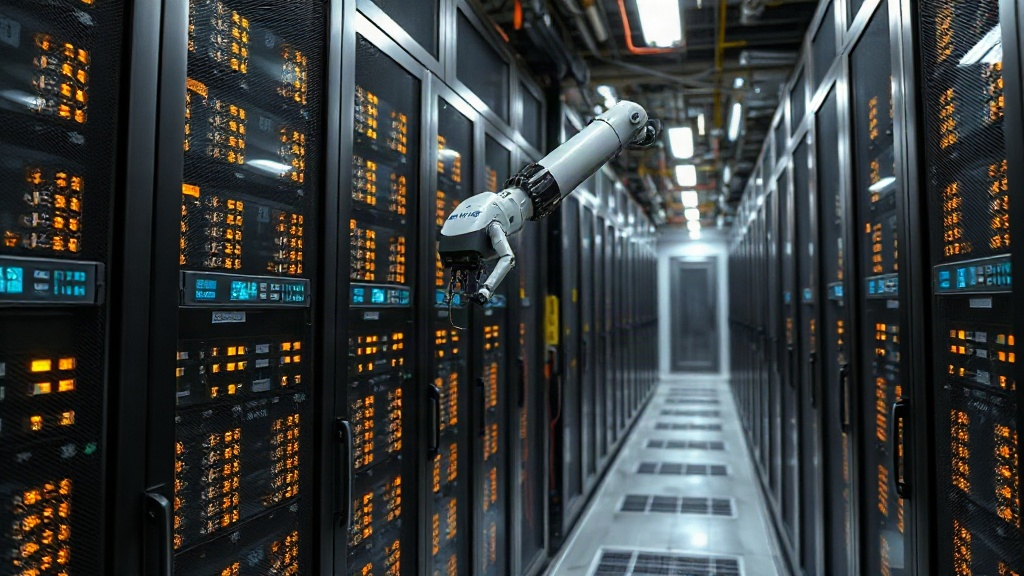
Meta’s data center robots swapping cables and resetting servers aren’t a novelty—they’re a signal that hyperscaler labor economics are beginning a structural reset. As Meta, Google, Microsoft, and Amazon automate the hands-on work that currently absorbs significant OpEx, your vendor contracts, pricing models, and infrastructure budgets will feel the ripple.
Meta’s data center robots swapping cables and resetting servers signal the next chapter in hyperscaler cost management. The headline is labor displacement—some workers estimate a successful cable-swapping robot could handle 80% of certain technician workloads. But the real story runs deeper: hyperscalers are automating the physical infrastructure layer itself, which means the cost structure of cloud services will eventually follow.
Why Now, Why It Matters
Data center labor isn’t a small line item. The ABC trade group forecasts that unfilled construction and operations positions will grow from roughly 349,000 in 2026 to 456,000 in 2027. Wages for specialized trades—electricians, HVAC engineers, commissioning experts—have climbed sharply as hyperscalers compete for the same shrinking pool of skilled workers. A single hyperscale campus can field crews of 4,000–5,000 workers during peak construction. Those crews cost money, and as AI workloads push power density higher (40–130 kW per rack), the technical precision required only rises.
Meta is testing robots from Watney Robotics, Kinova, and ABB at facilities including Altoona, Iowa, and New Albany, Ohio. Self-driving tugger robots already move server racks; wheeled inventory robots scan equipment. The next step—cable insertion, server power-cycling, component reseating—targets the labor-intensive, repetitive work that hasn’t yet been automated. And once these robots mature and scale, the economics of data center operations change. Fewer technicians, lower wage pressure, faster troubleshooting cycles.
That cost reduction doesn’t stay internal. Hyperscalers have no reason to absorb margin improvements. Over time, some of that efficiency will compete its way into customer pricing.
What This Means for Your Infrastructure Decisions
If you’re a mid-market manufacturer, distributor, or logistics operator running workloads on AWS, Azure, Google Cloud, or Meta’s inference infrastructure, your current vendor contracts were struck in an era when data center labor was a major constraint on capacity and pricing. As that constraint loosens, three things will likely change:
Pricing pressure on unit economics. If hyperscalers can operate facilities with 20% fewer technicians in three years, the math shifts. They may not cut cloud prices outright—publicly traded companies don’t volunteer margin cuts—but the cost basis for new capacity shrinks, and competitive bids will reflect that. Watch your renewal cycle closely.
Capacity and deployment timelines. Robots don’t need vacation or sleep. When technician availability stopped deployment, projects waited. When robots handle commissioning and maintenance, time-to-production for new infrastructure accelerates. That affects contract terms tied to guaranteed deployment dates or SLA response times.
Vendor lock-in intensifies. As hyperscalers invest billions in proprietary robot fleets and integrated automation, the gap between their internal efficiency and smaller providers’ costs widens. This makes it harder for mid-tier colocation or managed service providers to compete on operational cost. In turn, it concentrates more workload onto the big four.
The Workforce Story Is Real, But It’s Not the Business Story
Meta’s public position—that automation doesn’t mean fewer hires—isn’t cynical posturing. The company is right that labor shortages are acute. But the *composition* of labor will shift. Fewer cable-swappers; more roboticists, AI engineers, and automation specialists. Those roles pay differently, require different education, and concentrate in different geographies. For technicians doing repetitive hands-on work in data centers today, this is painful. For SMBs and mid-market operations dependent on cloud infrastructure, the transition is more subtle: you’ll benefit from lower operational costs at the hyperscaler level, but competitive pressure may not immediately reach you, because pricing power still favors the incumbents.
This echoes a pattern we’ve seen across manufacturing and logistics for the last decade. Robots arrive, labor displacement happens, eventually costs fall—but only when markets mature and competition forces the issue.
If you’re evaluating infrastructure strategy for 2027 and beyond, treat Meta’s robots as a signal, not news. The automation wave is real. Your vendor landscape is about to consolidate further, and the terms of infrastructure competition are shifting. Build that into your forecast.



0 Comments