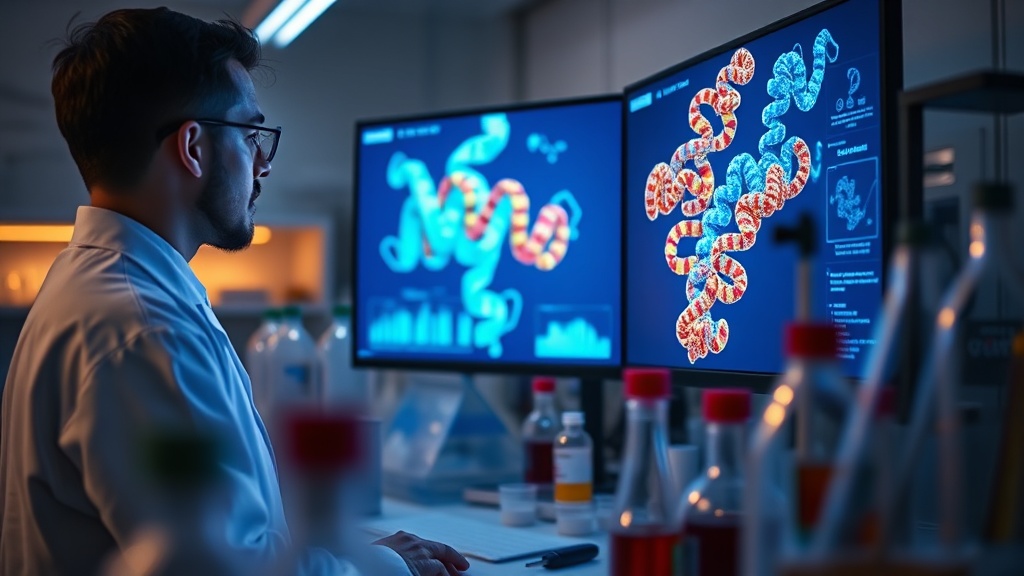
AI drug discovery protein design has quietly become the most consequential AI story of the year, and it has nothing to do with chatbots. MIT Technology Review’s deep dive into how machine-learning models help scientists design new proteins confirms what biotech insiders have been saying for months: the decade-long, billion-dollar grind of turning a target into a medicine is being compressed by tools that actually work in the lab. My take: this is the AI story mid-market biotech and pharma leaders should read this weekend, not another chatbot release.
Start with the number nobody argues about: most drug candidates fail, and the ones that don’t can take a decade and well over a billion dollars to reach a pharmacy shelf. That grinding, capital-hungry cycle is the actual subject of this week’s most important AI story, and it has nothing to do with chatbots.
What AI drug discovery protein design really solves
MIT Technology Review’s recent deep dive lays out the bottleneck plainly: biologic medicines are built from engineered proteins, not synthetic chemistry, and finding one that binds the right target, stays stable in the human body, and can be manufactured at scale means searching an almost incomprehensibly large space of possible molecules. That search used to be slow, expensive, and mostly manual.
Two things broke it open. AlphaFold2 solved the problem of predicting a protein’s 3D shape from its sequence, work that earned Demis Hassabis and John Jumper half of the 2024 Nobel Prize in Chemistry. The other half went to David Baker at the University of Washington, whose lab flipped the problem around: instead of predicting structures nature already made, generative diffusion models design entirely new proteins from scratch, built to order for a specific therapeutic job.
That second capability is where the real economic shift is happening. MIT’s Jameel Clinic released BoltzGen in October 2025, an open-source generative model that designs custom protein binders for a given biological target, reportedly built by a single PhD student, Hannes Stärk, over about seven months. Big pharma has noticed: Novartis’s president of biomedical research, Fiona Marshall, told C&EN she expects the company’s partnership with Isomorphic Labs to cut the time from idea to drug candidate by roughly 30%, meaning candidates that used to take three years could be lab-ready in 18 to 24 months. A peer-reviewed review also found that AI-developed candidates reaching Phase I trials by the end of 2023 succeeded at 80–90%, against a historical baseline closer to 40%, and PitchBook has floated the possibility that AI could roughly double the overall probability of approval, from around 8% to 18%.
Why the real story is a shrinking moat, not a faster lab
Here’s my thesis, and it’s why I think this deserves more attention than the next chatbot release: for decades, the biggest edge in biologics wasn’t a better idea, it was a bigger balance sheet. Big pharma could afford to fail nine times out of ten because it had capital and patience to run hundreds of parallel programs. A small biotech with one promising target and eighteen months of runway couldn’t play that game. AI-driven protein design doesn’t erase that asymmetry, but it narrows it: the years of wet-lab trial and error once needed to find a handful of viable binders among millions of possibilities can now be pre-filtered computationally before a single experiment runs.
Picture a hypothetical 30-person biotech spin-out in Lyon or Boston chasing a rare-disease antibody target big pharma has judged too small a market to prioritize. Five years ago, the realistic path was raising tens of millions, spending two to three years on hit-finding, and hoping enough budget survived to fund a Phase I trial. Today that same team can generate and computationally screen thousands of candidate binders in weeks, then send only the handful with the best predicted stability and binding affinity to the wet lab. That doesn’t shrink the cost of the clinical trial itself, and it doesn’t touch manufacturing scale-up or regulatory review — those remain genuinely hard and slow. What it does is let a small, well-capitalized team survive long enough to get a real shot at the clinic, a privilege that used to belong almost exclusively to companies with nine-figure R&D budgets.
I’d push back, though, on anyone reading this as “AI just solved drug discovery.” The Phase I numbers above are encouraging but early, and possibly selection-biased: teams running AI-designed programs today tend to be well-funded and working on targets chosen partly because they’re tractable for the models. Nobody has proven AI systematically raises the odds across the full range of disease biology, and nobody has proven it in a completed Phase III trial yet. Clinical validation is still catching up with the modeling breakthroughs — treat today’s numbers as a genuinely promising early signal, not a settled verdict.
What this means for your R&D roadmap
If you run or advise a mid-market biotech, a specialty CDMO, or a pharma R&D group, this is less about buying a fashionable tool than about where you spend a scarce budget:
- Map your actual bottleneck before shopping for AI. If your program is stuck at hit-finding, generative protein design can genuinely help; if it’s stuck at manufacturing scale-up or regulatory strategy, a protein-design license won’t move the needle.
- Data and domain fit beat brand names. An open model tuned on your target class can outperform an expensive proprietary platform poorly matched to your biology — test on your own validation data, not a vendor’s benchmark slide.
- Budget for the wet lab, not just the compute. Every AI-generated candidate still needs experimental confirmation; starving lab validation to fund more modeling runs just produces faster failures.
- Plan this as a multi-year capability, not a pilot. The firms compounding an advantage build a feedback loop between lab results and model retraining, rather than running one proof-of-concept and moving on.
There’s a broader lesson here too, for any mid-market company outside biotech: AI compressing the expensive, iterative middle of a hard technical process, while leaving the hardest, most regulated final steps untouched, shows up well beyond pharma. If part of your product-development cycle looks like “generate lots of candidates, test the few that survive,” it’s worth asking where an AI-assisted screening step could shorten your own runway.
FAQ
Does AI drug discovery protein design replace clinical trials?
No, and anyone telling you otherwise is selling something. AI compresses discovery and early optimization — finding and refining candidate molecules — but Phase I, II, and III trials still happen in real patients, on the same regulatory timelines as before. What changes is how many viable candidates you can afford to bring to that starting line, not how fast the starting line itself moves.
Can a small or mid-sized biotech actually afford these AI protein-design tools?
More than you’d expect. Open-source models like MIT’s BoltzGen lower the entry cost of the modeling layer, so the real spend shifts to talent that can use the tools well and to the wet-lab work needed to validate outputs. It’s a different cost structure, not necessarily a cheaper one overall — but one a well-funded 20-to-50-person team can now credibly compete in.
How soon will AI-designed drugs actually reach patients?
Faster on the discovery side, unchanged on the regulatory side. Programs using AI-driven protein design are moving into Phase I and II faster and, so far, with better early success rates than historical averages — but a medicine still needs to clear the full clinical and regulatory process, a matter of years, not months.
If this pattern — AI quietly rewriting the cost curve of a slow, expensive, iterative process — sounds familiar to your own R&D or operations, that’s usually the sign it’s worth a real conversation rather than another webinar. Take a look at what we build for mid-market teams, or if you’d rather just talk it through, tell me about your situation.
Sources
- How AI helps scientists design the next generation of medicines — MIT Technology Review
- MIT scientists debut a generative AI model, BoltzGen — MIT News
- New AI model could cut the costs of developing protein drugs — MIT News
- ‘We are in the century of the protein’ — C&EN
- AI In Action: Redefining Drug Discovery and Development — PMC
- AI-Enabled Clinical Improvements Confirm Biotech Hype as Success Rates Rise — BioSpace




0 Comments