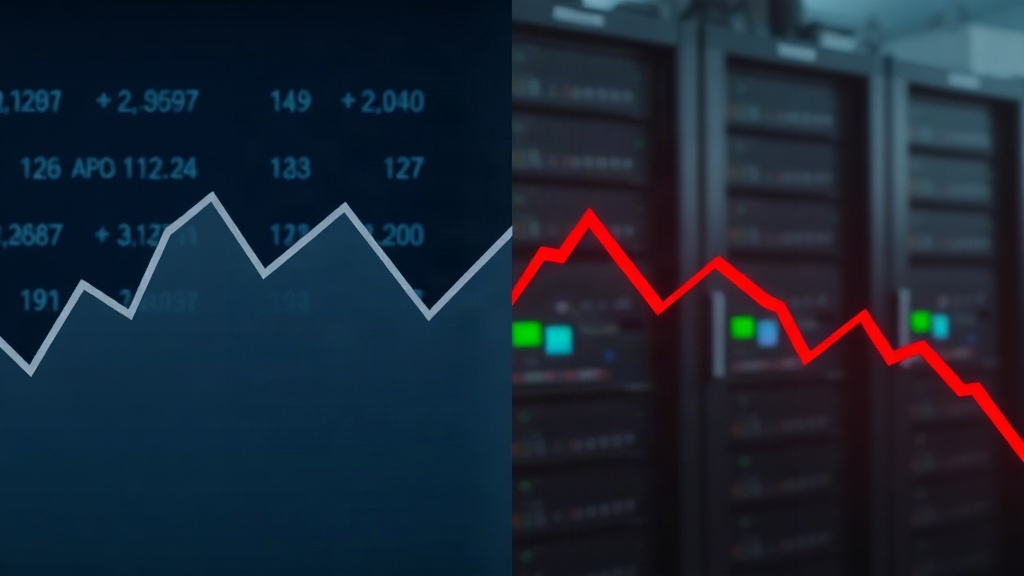
Hedgeye Risk Management just flagged Chinese AI competition as a material risk factor for Anthropic’s IPO. But the real story isn’t about Anthropic’s valuation—it’s that choosing a closed-source Western vendor now means absorbing a hidden geopolitical risk premium that open-source and Chinese alternatives don’t carry at all.
Hedgeye Risk Management just labeled Chinese AI competition as a material IPO risk for Anthropic. But here’s the part that matters for European SMBs: this isn’t about headline numbers. This is about geopolitical risk premiums being baked into Western vendor valuations while open-source and Chinese alternatives carry none. For you, picking an AI vendor for the next 18–36 months now means absorbing invisible geopolitical risk that your spreadsheet doesn’t show.
The math is brutal, and it’s getting worse
Felix Wang, Hedgeye’s managing director for global technology, told clients that Chinese open models were now taking market share from Anthropic and setting the lower bound for AI pricing. The disparity is stark: Claude’s output costs $50 per million tokens. DeepSeek costs 87 cents. That’s not margin compression—it’s market structure shifting.
Chinese models now account for 58% of tokens consumed on OpenRouter, with DeepSeek alone at 17.6% weekly, Alibaba’s Qwen at 13.9%. This isn’t experimentation. This is production workload migration. Anthropic’s Q3 revenue growth slowed to nearly 50%, down from earlier quarters, driven entirely by pricing pressure. The IPO valuation expectation fell from $2 trillion to $1.5 trillion.
Investors are asking the obvious question: what’s the moat if unit cost is 58x worse and the capability gap closes in months?
The lock-in trap you’re walking into
Imagine a 50-person logistics firm that’s spent 18 months building dispatch optimization on Claude. API integrations, ops training, code tuned to Claude’s latency. Today Claude costs $47,000 monthly; DeepSeek would cost $800. The feature gap closed three months ago.
Do they migrate? The sunk costs scream no. The capital recovery math screams yes. That’s vendor risk no one quantifies ahead of time.
If you’re a European SMB betting on a closed-source Western vendor, you’re making two implicit bets. First, that geopolitical barriers will hold and keep Chinese models out of your market. Second, that a 58x cost advantage never matures into feature parity. Both bets are tightening fast. DeepSeek trails Claude by months, not years. Large enterprises are already deploying Chinese models for production workloads.
The regulatory wall between Western and Chinese AI in Europe will soften. Market pressure ensures it will. When it does, you’ll be locked into a vendor whose unit economics are indefensible.
What to actually do about it
If you’re evaluating a multi-year AI infrastructure commitment, here’s what stress-testing looks like:
First: test your business case against a 50x cost undercut. If the math breaks, you don’t have a business case—you have a geopolitical arbitrage that depends on barriers never moving. That’s not strategy; that’s hope.
Second: architect for vendor switching as a real cost, not an impossibility. API abstraction layers. Careful avoidance of closed-source feature dependency. Open-weight model portability isn’t optional anymore—it’s resilience.
Third: seriously evaluate open-source alternatives. Not for ideology—for economics. Open-weight models trained on Chinese data now carry zero geopolitical valuation penalty, unlike Claude or OpenAI APIs. The financial market is already pricing in Chinese dominance; your capital budget should too.
Europe isn’t in the frontier AI race, and that’s actually an advantage here. You’re not building ChatGPT. You’re building logistics software, insurance validation, supply-chain agents. For that workload, the cost difference between Claude and DeepSeek is brutal and unsustainable. Europe’s smarter play is deployment and resilience, not frontier capability. The vendor economics just reinforced that.
FAQs: Vendor risk and Chinese AI
How fast will Chinese models actually reach feature parity with Claude?
DeepSeek demonstrates competitive performance across many benchmarks, though results are mixed. The real point: cost advantage of 58x or more makes timeline irrelevant. For production workloads, the price gap will force migration decisions regardless of feature parity.
Is vendor switching really feasible for production AI workloads?
It depends on architecture. If you’ve built on top of Claude API with minimal abstraction, you’re trapped. If you’ve designed for portability—API wrappers, model-agnostic prompting, output normalization—switching is expensive but possible. The question isn’t whether it’s feasible; it’s whether you designed for it from day one.
Should we prefer open-source models to avoid geopolitical risk entirely?
Open-source buys you resilience and cost, but trades away managed support and the margin that funds ongoing model development. The right answer isn’t open-source per se—it’s honest-eyed architecture that lets you switch when the math forces you to. Betting your business on a single vendor’s geopolitical safety is the real risk.
This is exactly the kind of structural vendor risk that gets overlooked until migration is already overdue. If you’re evaluating AI infrastructure for the next 2–3 years, you need to think through the geopolitical tail risk with clear eyes. Hedgeye’s signal is early, but the math is already baked in. Let’s talk about the vendor decision for your business if you want clarity on the TCO arithmetic.


0 Comments