Indonesia just launched its first university-based AI research center—a public-private partnership anchored at Universitas Gadjah Mada. But the real story isn’t about Indonesia. It’s about how emerging markets are building sustainable, cost-effective talent pipelines through government-backed university hubs, and why European SMBs facing intense AI hiring competition should pay attention.
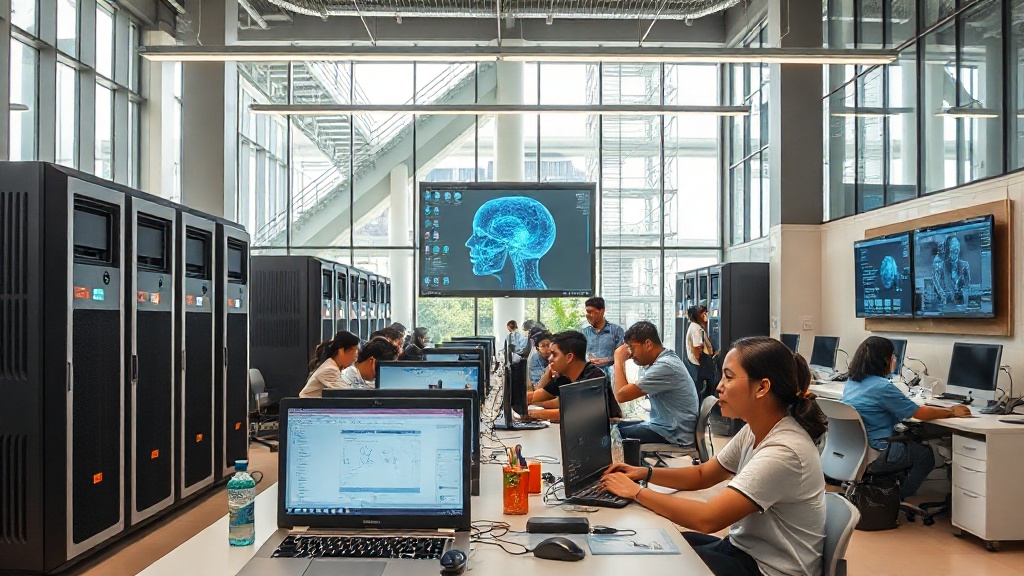
Indonesia’s Ministry of Communication and Digital Affairs, Indosat, NVIDIA, and Universitas Gadjah Mada opened the UGM Indosat NVIDIA AI Technology Center (NVAITC) on August 13, 2026, in Yogyakarta. It’s the country’s first university-based AI research center. The setup is straightforward: a government ministry, a telecom company, a chip vendor, and a university combine resources—GPUs, infrastructure, mentorship, pre-trained models—to train students and researchers on production-grade AI systems while solving real national problems.
This isn’t a news flash about Indonesia. It’s a case study in institutional design.
Indonesia set a target of producing 100,000 AI talents per year across different skill levels (from users to specialists). The government alone can’t hire them all or train them fast enough through traditional vocational routes. So instead of building a single national academy or waiting for the private market to solve the problem, Indonesia embedded the solution into universities. Give students access to enterprise-grade compute, pair them with industry mentors from Google DeepMind and university partners like the University of Tokyo (via JICA), let them work on real problems—eNose-TB screening for tuberculosis, SmartAgri for tropical agriculture, Tech4Disaster for flood prediction—and they graduate as AI engineers who can walk into a job on day one.
The math is instructive. Indonesia has recorded 108% growth in AI talent in the last year, ranking sixth globally and leading Southeast Asia. That’s not an accident. It’s the result of sustained policy design plus infrastructure investment.
Why European SMBs Should Notice This
Talent competition for AI skills is global now. A 40-person engineering consultancy in Stuttgart or Lyon competing for junior ML engineers is up against offers from Singapore, Dubai, and increasingly, emerging tech hubs. You can’t out-bid the big players. But you can out-partner them.
The Indonesia model works because it solves three SMB problems at once:
First, it de-risks early hiring. When a recent graduate comes from a university center like UGM Indosat NVAITC, they’ve already used the same frameworks and tools your company would use. They’ve worked on multi-disciplinary real-world projects. They’re not a coin flip; they’re pre-validated. Compare that to hiring a fresh grad from a traditional CS program who’s never seen a GPU cluster or worked with pre-trained models.
Second, it’s cost-effective. The government and anchor companies (Indosat, NVIDIA) absorb the infrastructure cost. Universities provide the student pipeline. You, the SMB, can access graduates without maintaining a training academy in-house. Indosat has already committed to free compute resources worth tens of millions of rupiah for UGM’s ongoing research; NVIDIA provides software and models at academic rates. The cost-per-talent-trained is orders of magnitude lower than a private bootcamp or hiring a consultant to build your own upskilling program.
Third, it’s locally anchored. A European SMB doesn’t need to hire talent from across the continent or rely on remote-only models. If a 50-person industrial automation firm in Lyons partners with a regional university—say, a local AI lab with even modest GPU capacity—it can create a direct pipeline: sponsor a capstone project, offer internships tied to your actual problems, hire the top performers, and build institutional continuity. The university gets research validation and industry connections. The students get real-world experience and jobs. You get a steady supply of pre-trained talent at much lower risk than cold recruiting.
Consider how this plays out in practice. Imagine a 25-person logistics optimization startup in Berlin. Instead of posting a job for a mid-level ML engineer and waiting six months while competing against cloud giants, they partner with Technical University Berlin (or ETH Zurich) to sponsor a semester-long project on route optimization using real supply-chain data. They provide cloud credits and a mentor. By month three, they’ve identified two or three students who can hit the ground running, they’ve improved their recruiting pipeline, and the university has research output. The cost to the startup: maybe €15–20K in time and credits. The value: a vetted, cheaper hire and a repeatable recruiting stream.
Indonesia’s 100,000-per-year target may not be directly transferable to Europe (different population, different labor dynamics). But the structural lesson is: government and industry don’t have to compete for talent. They can co-produce it.
Why This Matters More Than You Think
European SMBs are trapped between two pressures: AI skills are non-negotiable now (anyone competing on ops, customer service, or R&D needs AI fluency), but hiring in a tight labor market is brutal. Salaries have inflated. Relocation is hard. Remote hiring fragments your team.
The Indonesia model says: don’t hire talent, grow it. Partner with universities that have or can build compute capacity. Fund capstone projects or labs in exchange for first hiring dibs on top performers. Work with government innovation funds—most EU countries have them—to co-finance university infrastructure. The playbook exists. It’s just less visible in Western startup culture, which defaults to




0 Comments